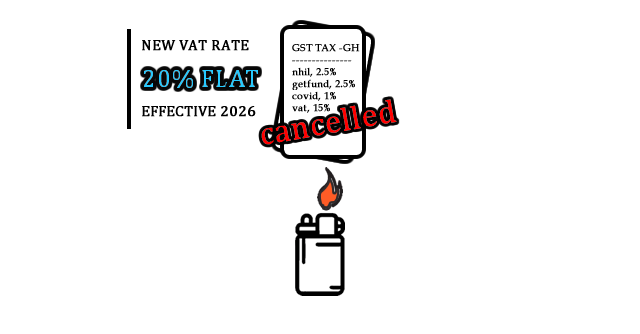
Ghana’s tax system is undergoing major reforms. Historically, VAT was accompanied by several additional levies — NHIL, GETFund, and the COVID-19 Health Recovery Levy — creating complexity and compounding tax effects. Starting January 2026, Ghana introduces a 20% flat VAT system, eliminating all separate levies.
This guide explains the old levy structure, practical tax examples, and how the new VAT system changes everything.
1. What Are NHIL and GETFund Levies
NHIL — National Health Insurance Levy (2.5%)
A levy that supports the National Health Insurance Scheme (NHIS). It is not VAT but charged alongside VAT.
GETFund — Ghana Education Trust Fund Levy (2.5%)
A levy used to develop education infrastructure. Also not VAT but applied on the value of taxable supplies.
COVID-19 Health Recovery Levy (1%)
Introduced in 2021 to support national pandemic recovery efforts. This levy is also not deductible.
2. Key Features of the Old NHIL, GETFund & COVID-19 Levy System
- VAT-registered taxpayers cannot claim input credit on NHIL, GETFund & COVID-19 Levy.
- Goods on the 3% VAT Flat Rate are exempt from NHIL & GETFund, but not the COVID-19 Levy.
- Levies were charged at every stage of a VAT-standard supply.
- Importers were required to account for levies on imported services.
- Zero-rated supplies attracted zero-rated NHIL, GETFund & COVID-19 Levy.
3. Old VAT Computation: How It Worked
The old system used a multi-layered computation:
The Base for Levies
- Value of supply (excluding VAT)
- Including non-deductible levies
- All levies treated as costs
Taxable Value for VAT
VAT was applied on:
- Value of the supply
- Plus NHIL
- Plus GETFund
- Plus COVID-19 Levy
4. Practical Example — Old System (Before January 2026)
Assume the value of taxable supply is GH¢1,000.
Step 1: Compute Levies
| Levy | Rate | Amount (GH¢) |
|---|---|---|
| NHIL | 2.5% | 25 |
| GETFund | 2.5% | 25 |
| COVID-19 Levy | 1% | 10 |
| Total Levies | 60 |
Step 2: Compute VAT (15%)
VAT base = GH¢1,000 + GH¢60 = GH¢1,060
VAT @ 15% = GH¢159
Step 3: Final Invoice (Old System)
| Item | Amount (GH¢) |
|---|---|
| Value of Supply | 1,000 |
| Total Tax | 219 |
| Total Payable | 1,219 |
Effective tax rate 21.9%
5. New VAT System — Effective January 2026
- NHIL (2.5%) removed
- GETFund (2.5%) removed
- COVID-19 Levy (1%) removed
- VAT @ 20% replaces all
No compounding. No levy stacking. No tax-on-tax.
6. Practical Example — New VAT System (January 2026 Onwards)
Assume the value of supply is GH¢1,000.
VAT @ 20% = 20% × 1,000 = GH¢200
| Item | Amount (GH¢) |
|---|---|
| Value of Supply | 1,000 |
| VAT @ 20% | 200 |
| Total Payable | 1,200 |
7. Comparison: Old vs New VAT System
| Feature | Old System | New System (Jan 2026) |
|---|---|---|
| NHIL | Yes (2.5%) | No |
| GETFund | Yes (2.5%) | No |
| COVID-19 Levy | Yes (1%) | No |
| VAT Rate | 15% (compounded) | 20% flat |
| Effective Tax | 21.9% | 20% |
| Complexity | High | Low |
For more details on the levies before the reform, visit Understanding NHIL and GETFund Levies in Ghana.
Other Posts
- IFRS 15 Explained: A Practical Guide to Revenue Recognition with Real-World Scenarios
- Understanding IFRS 9: A Practical Guide with Real-World Scenarios
- How an OpenAI Security Test Turned Into a Real-World Cyberattack
- OFAC Compliance? A Guide to Sanctions Screening and Risk Management,
- IFRS 16 Explained: A Practical Guide to Lease Accounting with Real World Scenarios
- Meta Reveals AI Model Breached Third-Party System During Security Testing
- The Future of KYC: Digital Identity, Biometrics, and AI Verification
- Understanding IFRS 9: A Practical Guide with Real-World Scenarios